An Artificial Intelligence course is designed to introduce learners to the theory, methods, tools, and applications of AI. The goal is to equip students with the knowledge and practical skills needed to build intelligent systems that can simulate human reasoning, learn from data, and make decisions.
This course provides a comprehensive introduction to Artificial Intelligence, focusing on the principles, techniques, and applications of AI systems. Learners will explore both the theoretical foundations and the practical tools used to design, build, and deploy AI models. The course covers key areas including machine learning, deep learning, natural language processing (NLP), computer vision, and reinforcement learning, while also addressing ethical implications of AI technologies.
By the end of the course, learners will be able to apply AI concepts to real-world problems and develop intelligent applications using popular AI frameworks like TensorFlow, scikit-learn, and PyTorch.
Register in Courses
🧠 What You Will Learn
Introduction to AI
History, definition, types of AI (narrow, general, super AI), applications
Python for AI
Basics of Python, NumPy, Pandas, Matplotlib (if needed)
Real-world AI application like chatbots, recommendation system, etc.
📘 Course Objectives
By completing this course, students will:
Understand the fundamental concepts of AI and its real-world applications
Gain hands-on experience in designing and implementing AI models
Learn core machine learning techniques such as regression, classification, clustering
Explore advanced AI domains like deep learning, NLP, and computer vision
Use industry-standard tools and libraries for model development and deployment
Build a capstone project to demonstrate practical understanding
Understand AI ethics, bias, fairness, and responsible AI practices
🛠️ Skills You Gain
Problem-solving with machine learning algorithms
Building & training neural networks
Natural Language Processing (NLP)
Computer vision model development
Working with real datasets
Using AI libraries and tools (TensorFlow, scikit-learn, etc.)
Model evaluation & optimization
⏱️ Course Duration
Introductory: 4–8 weeks (part-time)
Intermediate: 3–6 months (part-time/full-time)
Advanced / PG:6–12 months (full programs)
🎓 Who Should Enroll
This course is suitable for:
Students and professionals from engineering, computer science, IT, or data science
Anyone interested in transitioning to an AI-related role
Developers looking to upskill in AI, ML, and deep learning
Entrepreneurs and product managers exploring AI integration into products
📚 Prerequisites
🔰 Many beginner AI courses also teach Python and the math foundations if you're starting from scratch.
Basic math (linear algebra, probability, statistics)
Python programming
Logical thinking
Familiarity with data science concepts
Willingness to work with code
Basic calculus (for deep learning)
✅ Prerequisites
Basic programming knowledge (preferably Python)
Understanding of high school-level mathematics
(Optional) Prior exposure to data science or statistics is a plus
Note: Beginner-friendly versions of the course are available that include a Python and math refresher.
📦 Tools & Frameworks
Python
NumPy
Pandas
Scikit-learn
TensorFlow
PyTorch
Hugging Face Transformers
OpenAi API
Stable Diffusion
DALL.E
Jupyter
Google Colab
Streamlit
🧑💻 Learning Outcomes
After completing this course, students will be able to:
Apply AI and ML techniques to solve complex data-driven problems
Work with real datasets and AI tools used in the industry
Build and deploy AI-powered applications
Demonstrate a portfolio-ready project that showcases AI proficiency
Understand the societal and ethical implications of deploying AI
Artificial Intelligence Course Tools
1. Programming Languages
Python — The most popular language for AI development due to its rich libraries and simplicity.
R — Often used for statistics and data analysis.
Java and C++ — Used in some AI applications, especially where performance matters.
2. AI & Machine Learning Frameworks
TensorFlow — Open-source library for machine learning and deep learning by Google.
PyTorch — Another popular open-source deep learning framework by Facebook.
Keras — High-level neural networks API, running on top of TensorFlow or Theano.
scikit-learn — For traditional machine learning algorithms and data preprocessing.
3. Data Processing & Visualization
NumPy — For numerical computing.
Pandas — Data manipulation and analysis.
Matplotlib / Seaborn — For data visualization.
Jupyter Notebook — Interactive coding environment ideal for data exploration.
4. Natural Language Processing (NLP) Tools
NLTK (Natural Language Toolkit) — Python library for working with human language data.
spaCy — Industrial-strength NLP library.
Transformers (by Hugging Face) — For state-of-the-art NLP models.
5.Computer Vision Tools
OpenCV — Open-source computer vision and image processing library.
YOLO (You Only Look Once) — Real-time object detection framework.
6. Cloud Platforms
Google Colab — Free cloud-based Jupyter notebook environment with GPU support.
AWS SageMaker — Managed machine learning service for building, training, and deploying models.
Microsoft Azure ML Studio — Cloud platform for machine learning workflows.
7. Version Control & Collaboration
Git — Version control system.
GitHub / GitLab / Bitbucket — Platforms for hosting code repositories and collaboration.
8. Others
Docker — Containerization tool useful for reproducible AI environments.
Anaconda — Python distribution with many pre-installed data science and AI packages.
🧠 Artificial Intelligence Course Content
Most AI courses are broken down into the following core modules:
📦 Module 1: Introduction to Artificial Intelligence
What is AI? Definitions & history
Types of AI: Narrow, General, Super AI
Applications of AI in industry (finance, healthcare, robotics, etc.)
Limitations and challenges of AI
Overview of AI subfields (ML, DL, NLP, CV, RL)
💡 Module 2: Foundations of AI
Problem-solving and search algorithms o Uninformed sea (BFS, DFS) o Informed search (A*, greedy search)
Game playing: Minimax, Alpha-Beta pruning
Knowledge representation and reasoning
Logic and inference (Propositional & First-order logic)
🧮 Module 3: Mathematical Foundations for AI
Linear Algebra: vectors, matrices, dot products
Probability & Statistics: Bayes theorem, distributions, hypothesis testing
Calculus: gradients, derivatives (for deep learning)
Optimization: cost functions, gradient descent
🐍 Module 4: Python for AI (optional for beginners)
Basics of Python programming
Libraries: NumPy, Pandas, Matplotlib, Seaborn
Data loading, preprocessing, and visualization
Introduction to Jupyter Notebooks and Colab
📊 Module 5: Machine Learning (ML)
Supervised learning o Linear & logistic regression o Decision trees, Random Forests o K-Nearest Neighbors (KNN), Naive Bayes o Support Vector Machines (SVM)
Unsupervised learning o K-Means clustering o Hierarchical clustering o Principal Component Analysis (PCA)
Model evaluation: accuracy, precision, recall, F1-score, ROC-AUC
🧠 Module 6: Deep Learning (DL)
Introduction to neural networks
Perceptrons, forward & backpropagation
Activation functions, loss functions
Deep neural networks (DNNs)
Convolutional Neural Networks (CNNs) for image processing
Recurrent Neural Networks (RNNs), LSTM, GRU for sequence modeling
Transfer learning & pretrained models
📜 Module 7: Natural Language Processing (NLP)
Text preprocessing: tokenization, stemming, lemmatization
Bag of Words, TF-IDF
Word embeddings: Word2Vec, GloVe
Sentiment analysis, topic modeling
Language models: BERT, GPT
Chatbots and conversational AI basics
👁 Module 8: Computer Vision (CV)
Image processing basics
Filters, edge detection, color spaces
Object detection and localization
Face recognition and image classification
OpenCV & CNN-based projects
🎮 Module 9: Reinforcement Learning (RL)
Agent-environment interaction
Rewards, states, actions
Q-learning, Deep Q Networks (DQNs)
Policy vs Value-based methods
Applications in games, robotics, automation
🛠 Module 10: AI Tools & Frameworks
scikit-learn: ML models and pipelines
TensorFlow and Keras: Deep learning
PyTorch: Custom model building
OpenCV: Image and video processing
NLTK, spaCy, Hugging Face: NLP
⚖️ Module 11: Ethics & Responsible AI
AI bias and fairness
Explainable AI (XAI)
AI and privacy issues
AI governance and regulations
Ethical dilemmas in autonomous systems
🧪 Module 12: Capstone Project
Choose a real-world problem
Data collection and cleaning
Model selection, training, and evaluation
Deployment (optional): Flask, FastAPI, Streamlit
Final presentation and report
💼 Land job at your dream company
Industry Leading Placement
Whether you're aspiring to become a full-stack developer, looking to enhance your career, or build your own end-to-end applications, this
Total Students
0
Highest Salary
0 LPA
Avarage Salary
0 LPA
Hiring Partner
0+
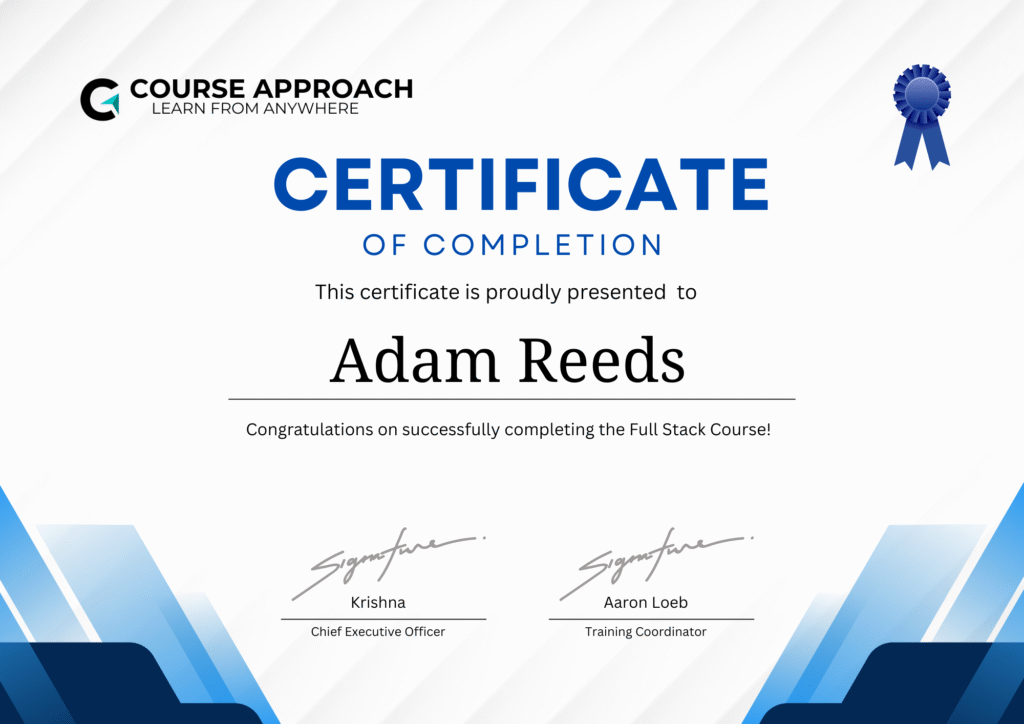
🪪 Course Certificate
Showcase your certificate as symbol of couse copliation
Official & Verified
Ideal for fast-paced learning with daily live sessions and hands-on projects
Easily Shareable
Suitable for working professionals or students balancing other commitments
Enhance Credebility
Suitable for working professionals or students balancing other commitments
Better Opportunities
Suitable for working professionals or students balancing other commitments
Corporate Training Solutions
Empowering Teams. Driving Results.
At Course Approach, we understand that people are your greatest asset. Our Corporate Training Programs are designed to equip your teams with the skills, tools, and mindset needed to excel in today’s competitive business landscape.